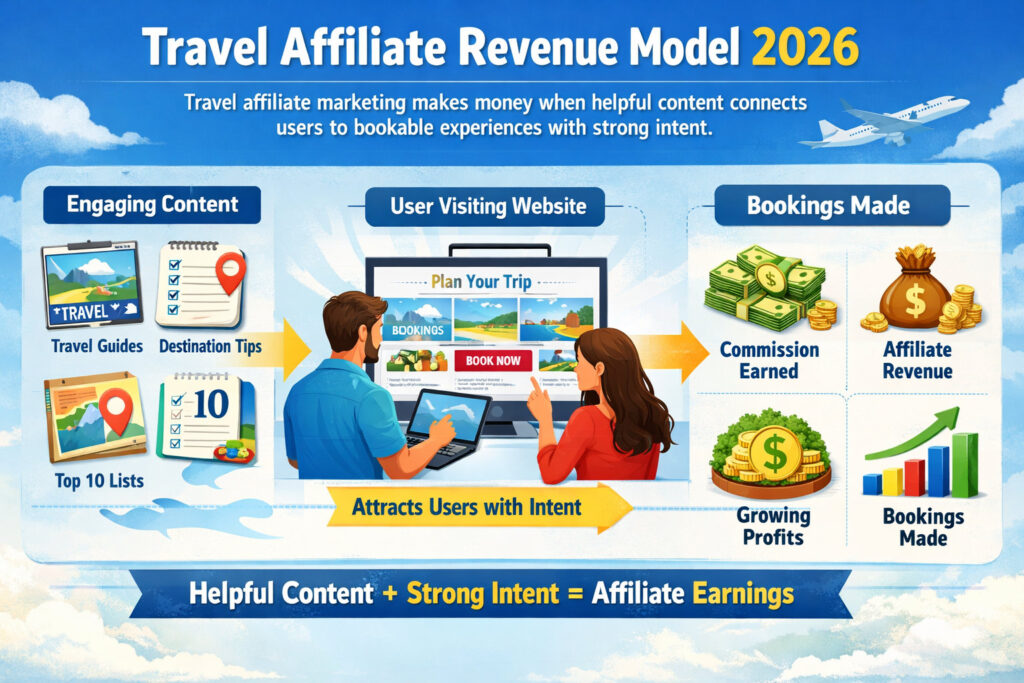
Automated travel affiliate websites are appealing for one obvious reason: they promise a way to connect content, travel inventory, and affiliate monetization more efficiently than a fully manual workflow.
That appeal is real, but it is also easy to misunderstand.
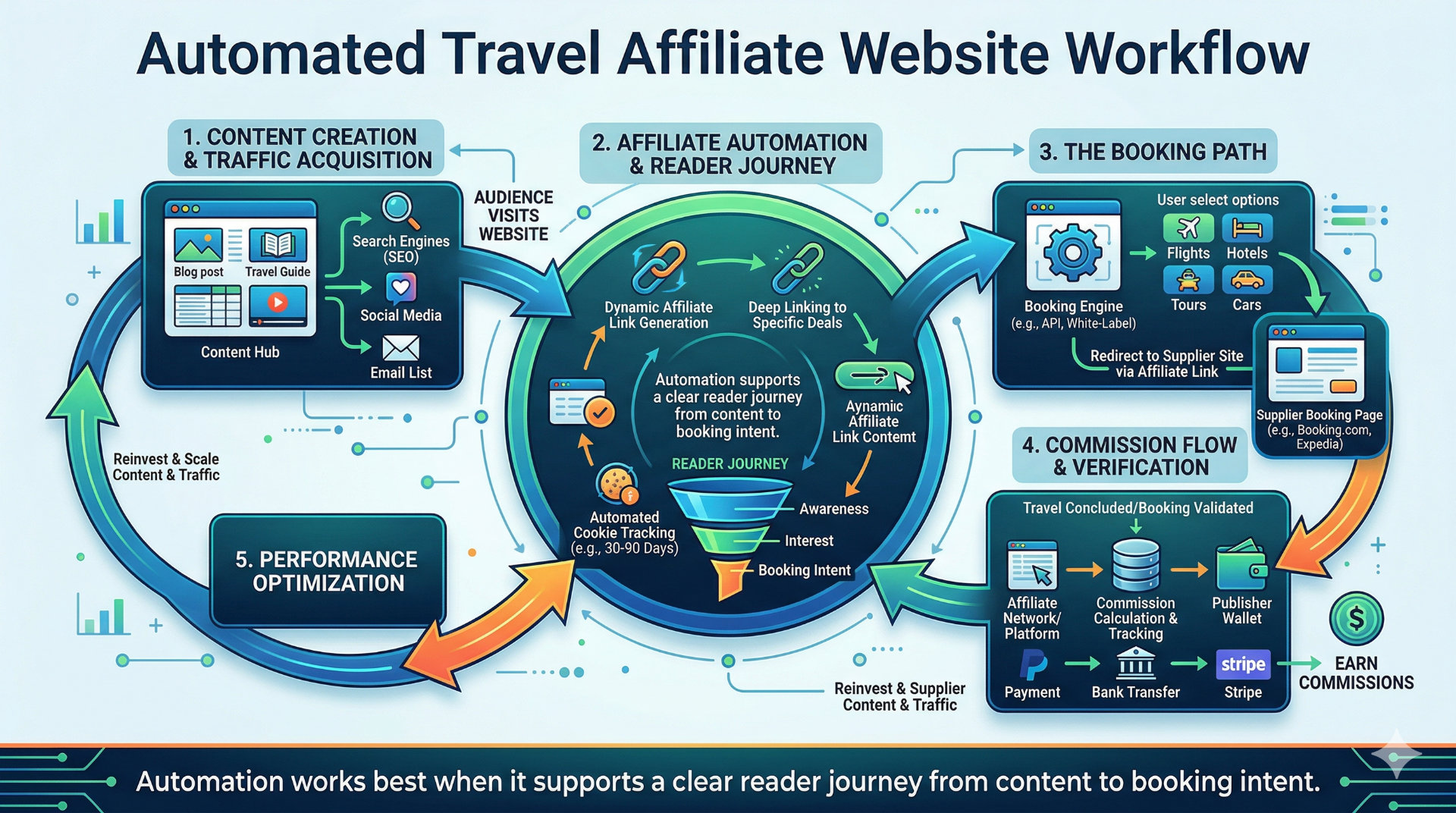
An automated travel affiliate website is not a magic website that earns money without work. In practice, it usually means a site where parts of the publishing or monetization process are made more repeatable. That can include structured product feeds, widgets, affiliate APIs, reusable recommendation blocks, search forms, white-label flows, or WordPress plugins that reduce manual copy-paste work. The value of automation is not that it replaces strategy. The value is that it reduces friction once the strategy is clear. (Viator Partner Resource Center)
What “automated” actually means in travel affiliate publishing
In travel affiliate publishing, automation usually sits somewhere on a spectrum.
At the light end, automation may simply mean using affiliate links, banners, widgets, or search forms provided by a partner program. At the more structured end, it may mean using an affiliate API, a white-label search experience, or a plugin-based workflow that helps surface inventory, pricing, availability, and booking pathways more consistently. Viator describes its Affiliate API as a content-only API that allows partners to scale travel experiences inventory across their own sites while earning commission on bookings. Travelpayouts, by comparison, provides a broader affiliate platform and WordPress plugin ecosystem that can surface tools such as search forms, widgets, and white-label flows. (Viator Partner Resource Center)
That distinction matters because “automated” does not describe one product category. It describes a family of implementation choices.
If you are still setting up the broader model, this article pairs naturally with How to Start a Travel Affiliate Blog That Generates Passive Income and How to Make Money with Travel Affiliate Marketing in 2026.
Why automated travel affiliate websites have become more attractive
Automation has become more attractive because the manual version of travel affiliate publishing gets harder to manage as a site grows.
A few articles can be handled with copy-paste links and basic CTAs. A larger content library is different. Once a site starts publishing destination guides, “best tours” posts, comparison pages, and recurring booking-intent content, manual workflows often become slower, more repetitive, and less consistent.
At the same time, user expectations have changed. Readers now expect cleaner site experiences, clearer recommendation formats, and less friction between content and booking decisions. Google’s guidance has not created a special SEO formula for AI features, but it does reinforce the same fundamentals: useful, people-first content, crawlable pages, clear site structure, and content that genuinely helps users decide what to do next. Automation can support that if it improves structure and usability rather than creating thin, low-value pages at scale. (Viator Partner Resource Center)
The main automation models worth understanding
Before evaluating tools, it helps to understand the main models on the market.
1. Manual links plus lightweight tools
This is the simplest route. Publishers use affiliate links, banners, or widgets directly from a partner program. Viator, for example, supports affiliate links and lightweight partner tooling alongside its API route. This model is easy to start with, but it tends to become repetitive on content-heavy sites. (Viator Partner Resource Center)
2. Partner API workflows
This route is more structured. Viator’s Affiliate API, for example, is built for partners who want to merchandise tours and experiences on their own sites while earning commission on bookings. API-based workflows make more sense for publishers who want richer content-to-booking pathways and more repeatable site structures. (Viator Partner Resource Center)
3. Broader affiliate platforms
Platforms like Travelpayouts are broader than a single supplier relationship. They give affiliates access to multiple travel brands and tools through one ecosystem, including WordPress plugin workflows and white-label options. This can be attractive for publishers whose sites span multiple travel verticals rather than one tours-and-experiences partner model. (support.travelpayouts.com)
4. Theme-dependent or portal-style implementations
Some solutions sit between plugin convenience and bigger booking infrastructure. Traveler’s Viator add-on is a theme-dependent option for publishers already inside the Traveler ecosystem, while Adivaha emphasizes more portal-style or on-site booking-style Viator integrations with real-time inventory, pricing, and availability. These routes can be useful, but they solve a somewhat different problem from a lighter affiliate-publisher workflow. (CodeCanyon)
Compare automation models before choosing your stack
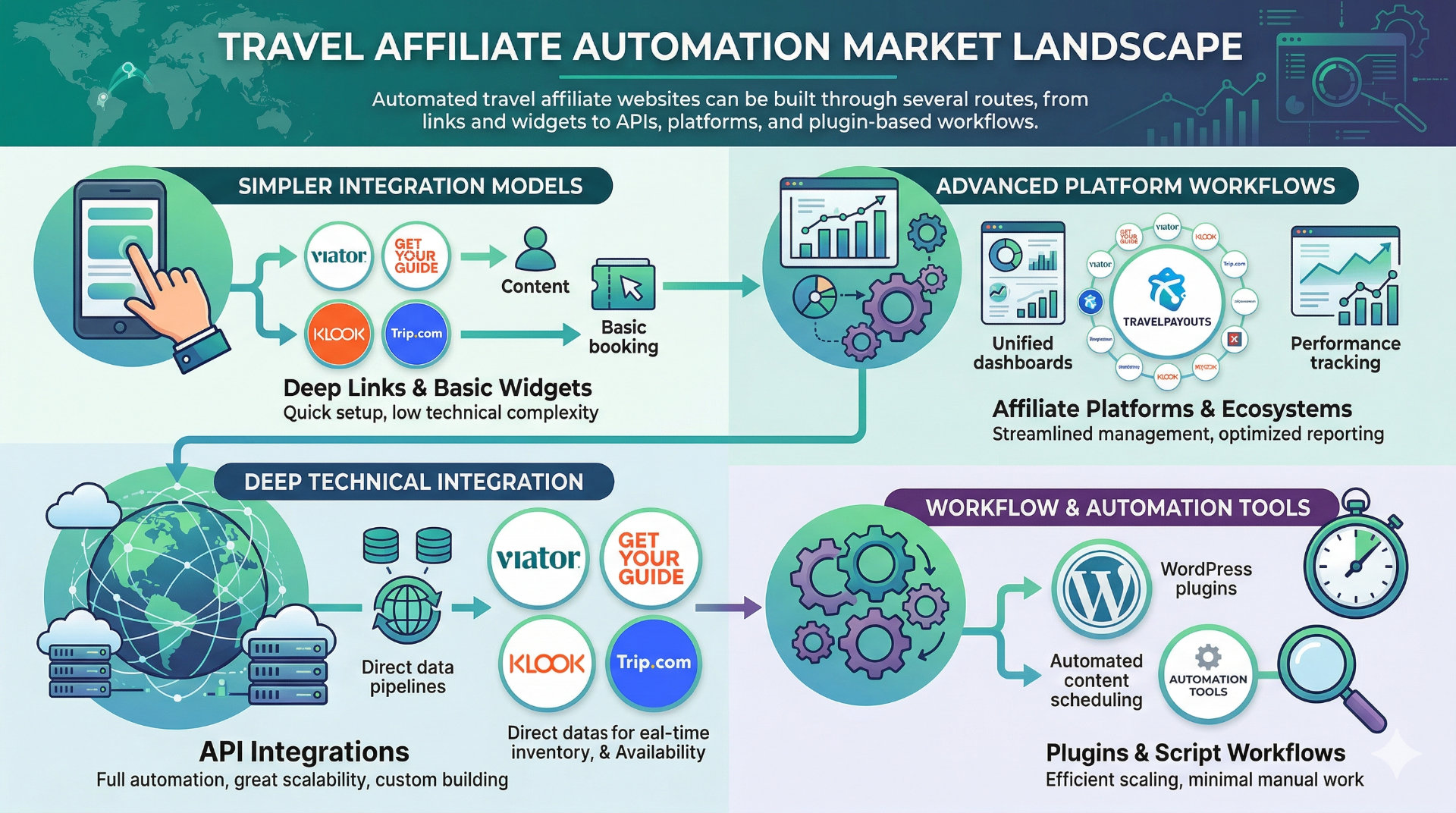
Not every automated travel affiliate website works the same way. Some publishers use affiliate links and widgets, some rely on partner APIs, some use broader platforms like Travelpayouts, and others build around WordPress plugin workflows. The best route depends on your niche, content model, and how structured you want the site to become.
The broader market landscape you should not ignore
A common editorial mistake is to talk about travel affiliate automation as if one ecosystem defines the whole market.
It does not.
If your site is centered on tours and experiences, Viator is one of the strongest routes to evaluate, but it is not the only one. GetYourGuide also promotes partner and affiliate routes for creators and publishers. Klook runs an affiliate program for website traffic and travel audiences. Trip.com operates a partner ecosystem across multiple travel verticals. Travelpayouts sits in a broader category again by aggregating tools and offers from multiple travel brands. Each of these models can make sense depending on whether your site is narrow and experience-led, or broad and multi-vertical. (Viator Partner Resource Center)
That is the first rule of building a trustworthy automated affiliate site: understand the market before you understand the tool.
Why Viator is often a central example in this category
For tours-and-experiences publishers, Viator is often a central example because its affiliate model maps cleanly to the kinds of pages those sites already publish: destination guides, activity roundups, “best tours” articles, and other decision-stage content.
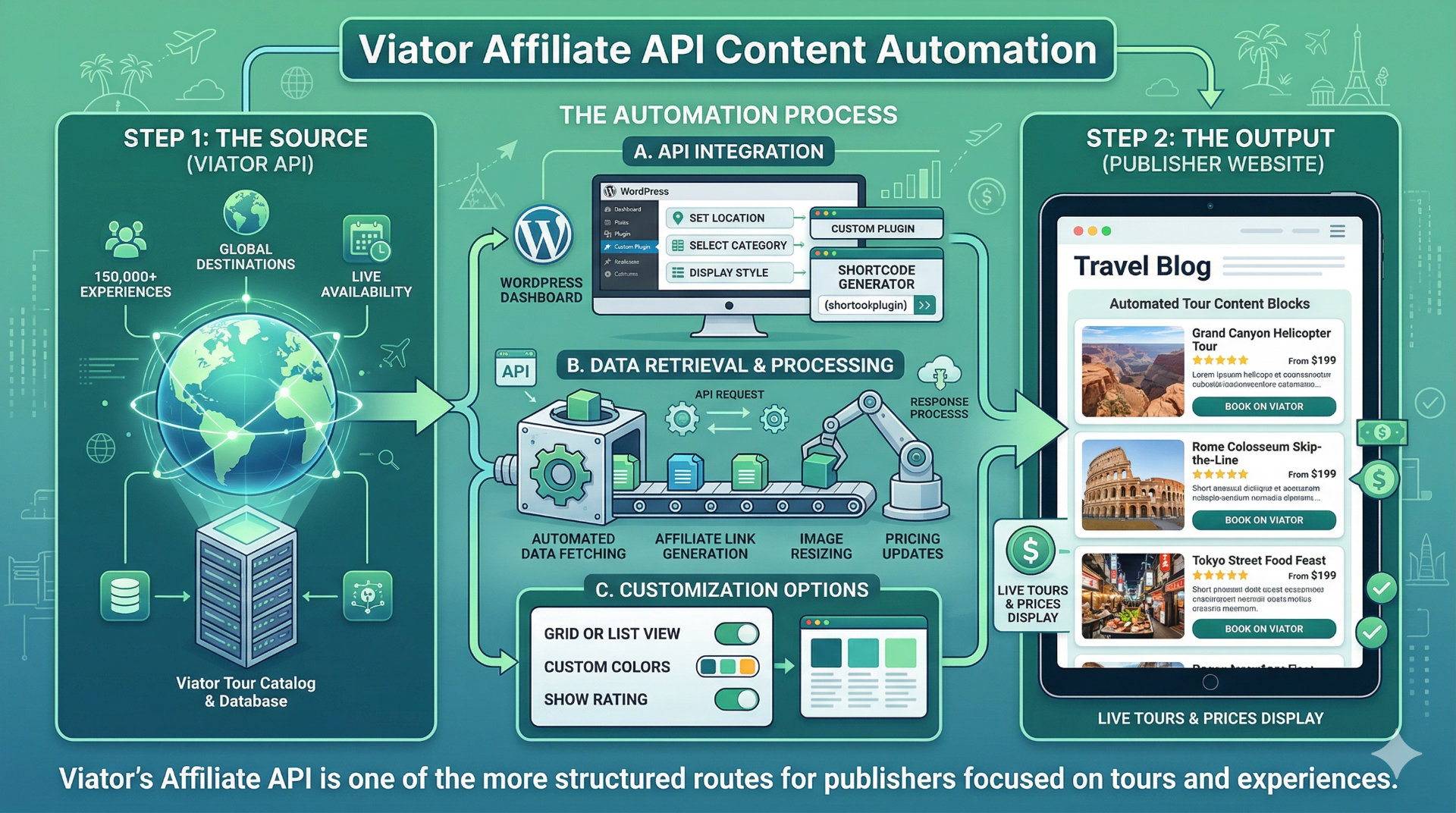
Viator says its Affiliate API gives partners access to 300,000+ experiences and is designed to help them scale inventory across their own sites while earning commission on each booking. Viator’s partner materials also describe free signup, Basic Access for new affiliate accounts, and a 30-day cookie window for referral-based bookings to viator.com. That makes it easier to use Viator as a reference model when discussing what “structured travel affiliate automation” looks like in practice. (Viator Partner Resource Center)
Competitor and substitute workflows worth understanding
Not every automated travel affiliate website uses the same type of infrastructure.
Some WordPress publishers look at Traveler’s Viator add-on because it is already built into a theme ecosystem. Others look at Adivaha because it leans more toward a portal-style, white-label-style workflow with on-site booking logic. Some skip single-supplier depth entirely and prefer Travelpayouts because it offers broader multi-brand coverage through one platform. And many early-stage sites still begin with lightweight links or widgets because the simplest automation is sometimes enough at the beginning. (CodeCanyon)
That is why “automated travel affiliate website” should never be treated as a synonym for one company or one plugin. It is a category with multiple valid interpretations.
This section connects naturally to Travel Affiliate API vs Manual Affiliate Links: Which Is Better? and Best Travel Affiliate Tools for Publishers in 2026.
Where Travaff fits in this picture
This is where the WordPress-specific implementation question becomes much more concrete.
If a publisher has already decided that Viator is the affiliate model they want to build around, then the next practical question is how to implement that cleanly on WordPress. One option in that narrower scenario is Travaff’s Viator Affiliate API WP Plugin.
Travaff positions the plugin as a quick-launch WordPress workflow with blocks or shortcodes, live sync, and auto-generated deeplinks for publishers using their own Viator affiliate credentials. Travaff’s public product materials also emphasize zero-coding setup and a faster implementation path for WordPress users who want something more structured than manual link management. That does not make Travaff the answer for every site. It makes Travaff a relevant option for a specific use case: WordPress publishers who are already committed to a Viator-centered automation model. (travaff.com)
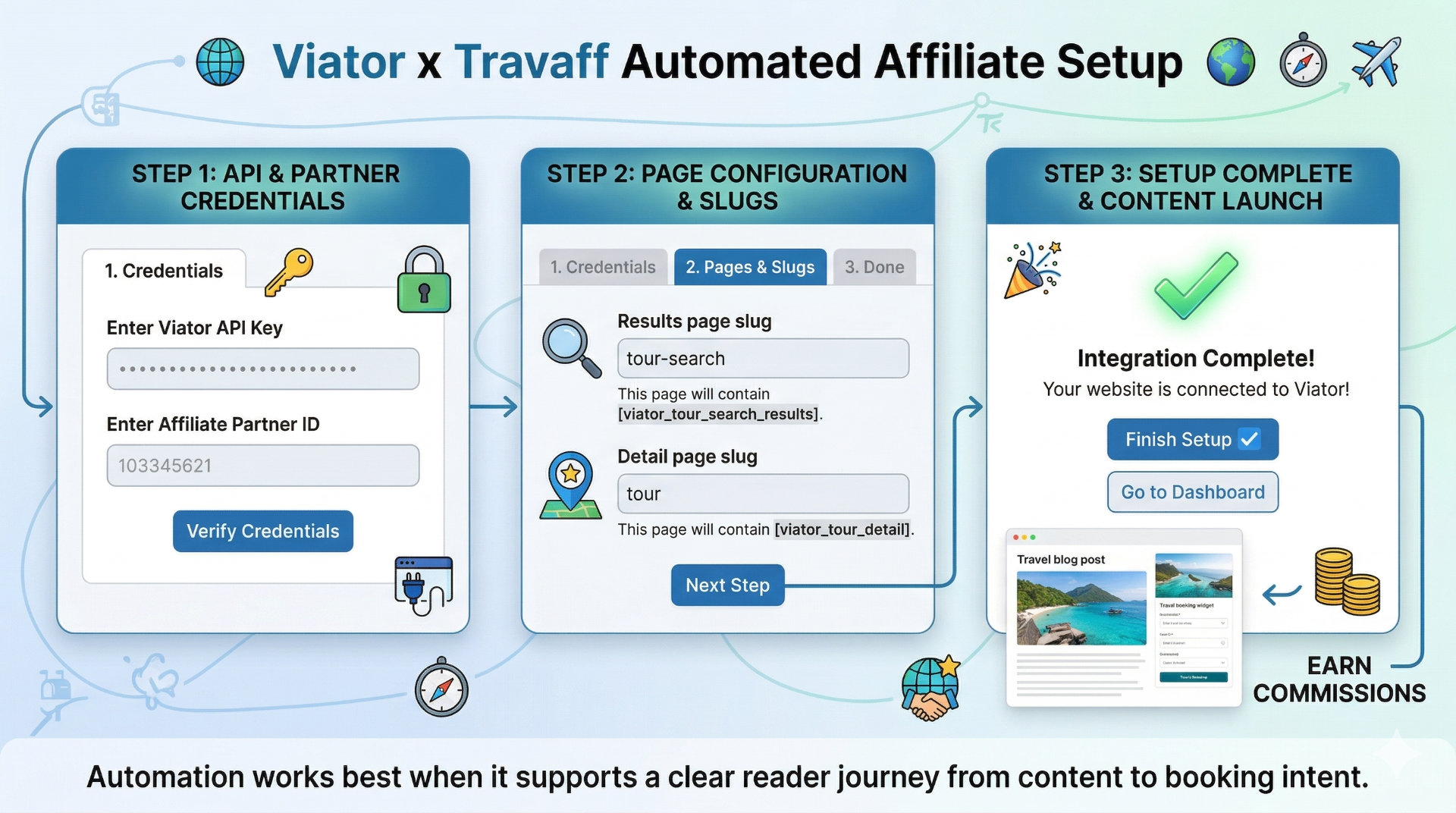
Building around Viator on WordPress? Here is one practical route
If your site is already centered on Viator’s affiliate model, Travaff’s Viator Affiliate API WP Plugin is one option worth considering. It is positioned as a quicker WordPress implementation path for publishers who want blocks, shortcodes, live sync, and less manual link work.
This section also pairs naturally with How to Maximize Revenue from Viator Affiliate Programs and Travaff.com Review: Is It a Smart Solution for Travel Affiliates?.
What automation can and cannot do
Automation can help a travel affiliate site become more structured, more repeatable, and easier to manage.
It can reduce:
- manual copy-paste work
- inconsistent recommendation formatting
- repetitive link handling
- some content-to-monetization friction
- some maintenance overhead on inventory-driven pages
But automation cannot fix:
- a weak niche
- unhelpful content
- poor editorial judgment
- unclear internal linking
- pages with no real booking intent
- thin content created just to fill a site
That is an important distinction because Google’s guidance on helpful content and AI features still points to the same baseline: content should be created for people first, add real value, and avoid scaled low-value publishing. Automation is helpful when it supports that standard, not when it tries to replace it.
The best content structure for an automated travel affiliate site
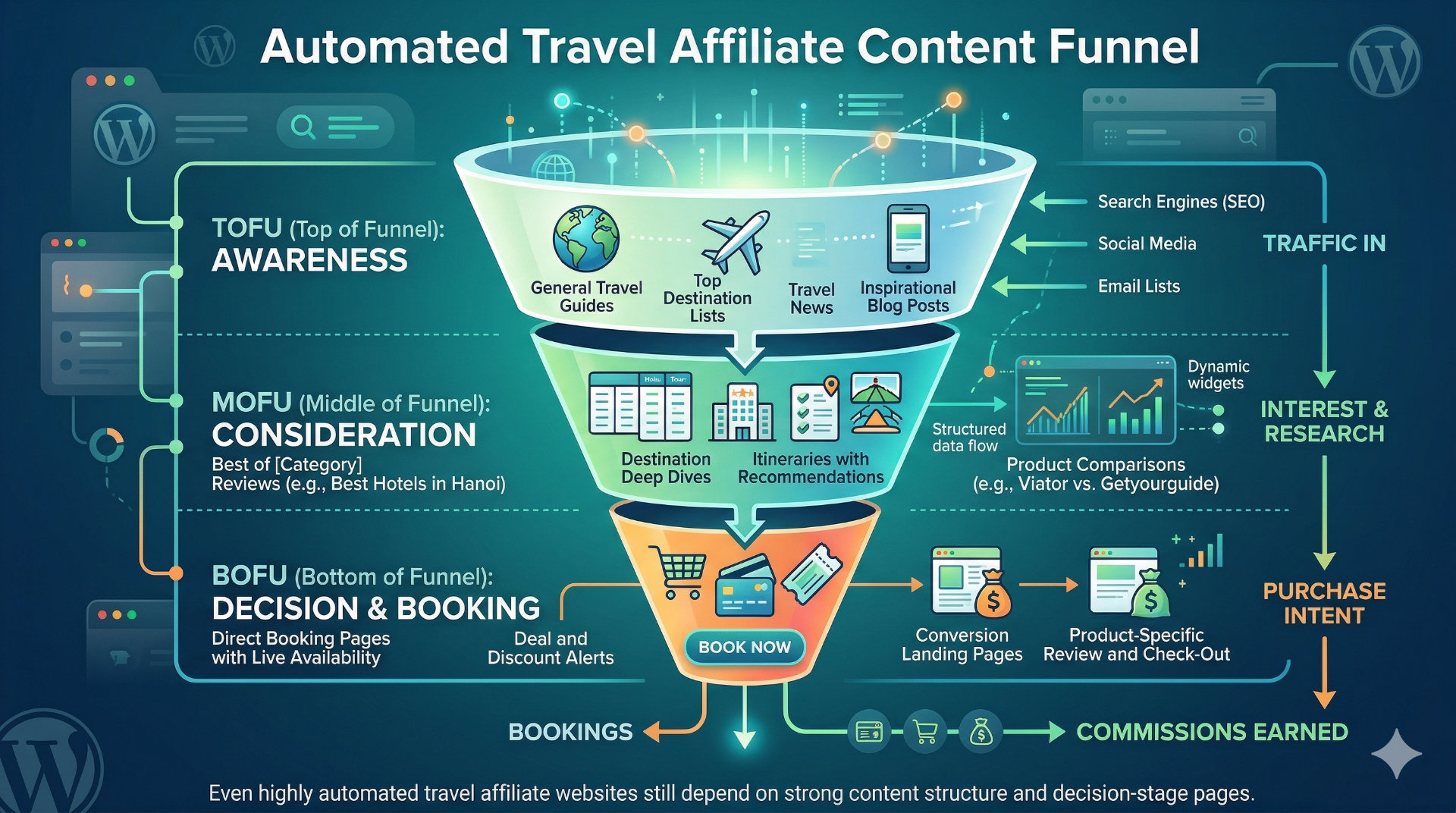
Even highly automated sites still depend on strong content structure.
The most effective model usually looks like this:
Top-of-funnel content
Destination and planning pages that attract the right readers.
Mid-funnel content
Comparison pages, “best tours” guides, and narrowing pages that help readers evaluate options.
Bottom-of-funnel content
Decision-ready pages that make the next step obvious.
Automation works best when it supports that funnel rather than trying to bypass it. An API or plugin can make product presentation more efficient, but the content still has to earn trust and move the reader toward a decision.
This is a good place to link to How to Build a Travel Affiliate Website with WordPress Plugins and How to Optimize a Travel Affiliate Funnel for More Revenue.
A practical way to choose the right automation level
A simple rule works well here:
- if the site is a small test, start light
- if the site is content-heavy and niche-focused, automation becomes more valuable
- if the site is broad and multi-vertical, a broader affiliate platform may fit better
- if the site is centered on Viator and WordPress, a more focused implementation route may make sense
- if the site is trying to behave like a travel portal, theme-dependent or portal-style solutions may deserve a closer look
That is the balanced answer.
The best automated travel affiliate website is not the one with the most tech. It is the one where the level of automation matches the business model.
Final thoughts
Automated travel affiliate websites can be powerful, but they only work well when automation is used to support a clear publishing strategy.
Start with the niche.
Understand the affiliate landscape.
Choose the automation model that fits the site you actually want to run.
And only then decide whether you need links, widgets, a broader platform, an API, or a WordPress implementation layer.
For some publishers, a lightweight model is enough. For others, especially those building around Viator on WordPress, a more structured route such as a plugin-based implementation may be worth considering. The right answer depends less on hype and more on fit.
Build an automation stack that fits the site you actually want to run
The smartest automated setup is not the most complicated one. It is the one that supports your content model, your publishing workflow, and the type of travel affiliate business you are actually building.
FAQ
What is an automated travel affiliate website?
It is a travel affiliate site where part of the content-to-monetization workflow is made more repeatable through tools such as links, widgets, APIs, white-label flows, or plugin-based implementations. (Viator Partner Resource Center)
Are automated travel affiliate websites fully passive?
No. Automation can reduce repetitive work, but the site still needs strategy, useful content, internal structure, and regular editorial decisions.
Is Viator the only route for automation?
No. Viator is one of the strongest examples for tours and experiences, but GetYourGuide, Klook, Trip.com, and Travelpayouts are also relevant parts of the market. (Viator Partner Resource Center)
Where does Travaff fit best?
Travaff fits best for WordPress publishers who are already building around Viator and want a more structured implementation path for that specific affiliate workflow. (travaff.com)